The four reports
Open AI reports in the sidebar. Four kinds of report can be generated at any time with one click:
- Daily brief: the last 24 hours across your brand, competitors and industry.
- Weekly summary: the last seven days, with sentiment and the main developments.
- Competitor report: competitor activity and how their messaging compares, over the last week.
- Emerging trends: topics that are growing in your coverage over the last 30 days.
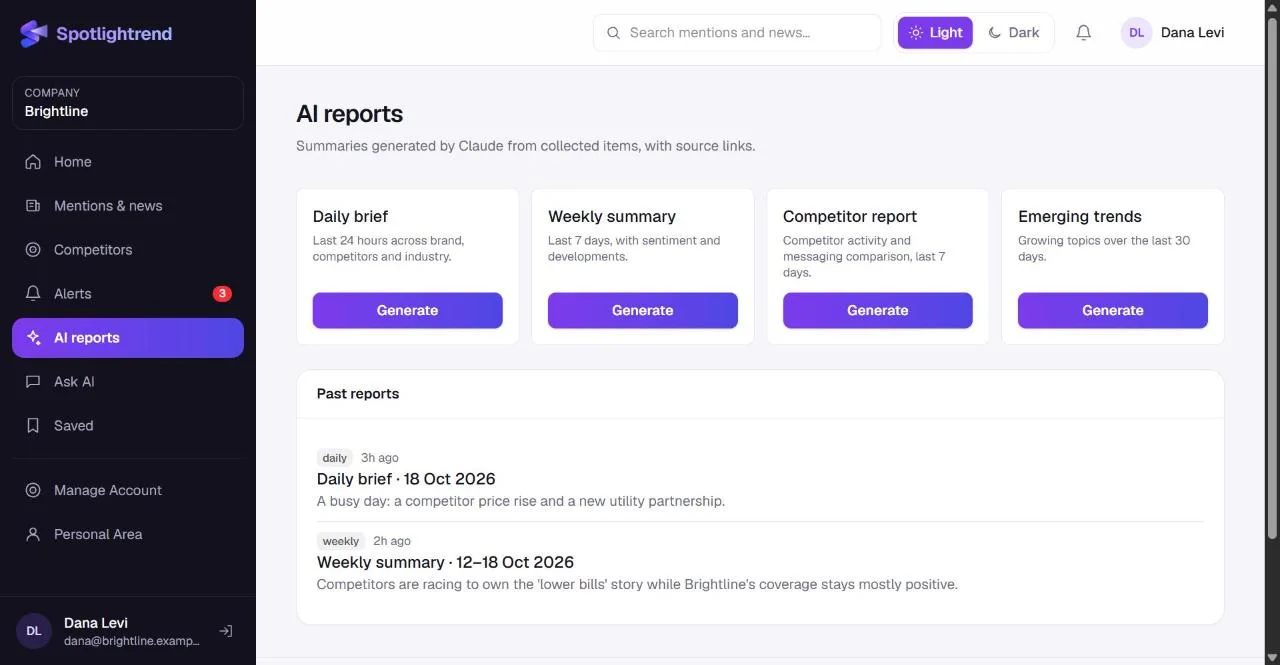
The daily brief is generated every morning and the weekly summary every Monday, so they're waiting when you sign in. Past reports stay in the list below.
Which report to use when
Use the daily brief for the morning check: it's short on purpose. The weekly summary is the one to forward to leadership or paste into a team update. The competitor report is better before a pricing discussion or a sales kick-off, because it puts the competitors side by side instead of mixing them with your own coverage. Emerging trends is the slow one: look at it once a month to spot themes that keep growing, like a regulation or a new technology people start writing about.
How a report is structured
Every report starts with a one-line headline and then three sections, each with its own color.
- Verified facts (green): statements directly supported by the cited sources. Each ends with a number in brackets.
- Interpretation (amber): the model's analysis and inference. Useful, but it's an opinion.
- Opportunities (blue): suggestions for what your team could do. Treat them as a starting point for discussion.
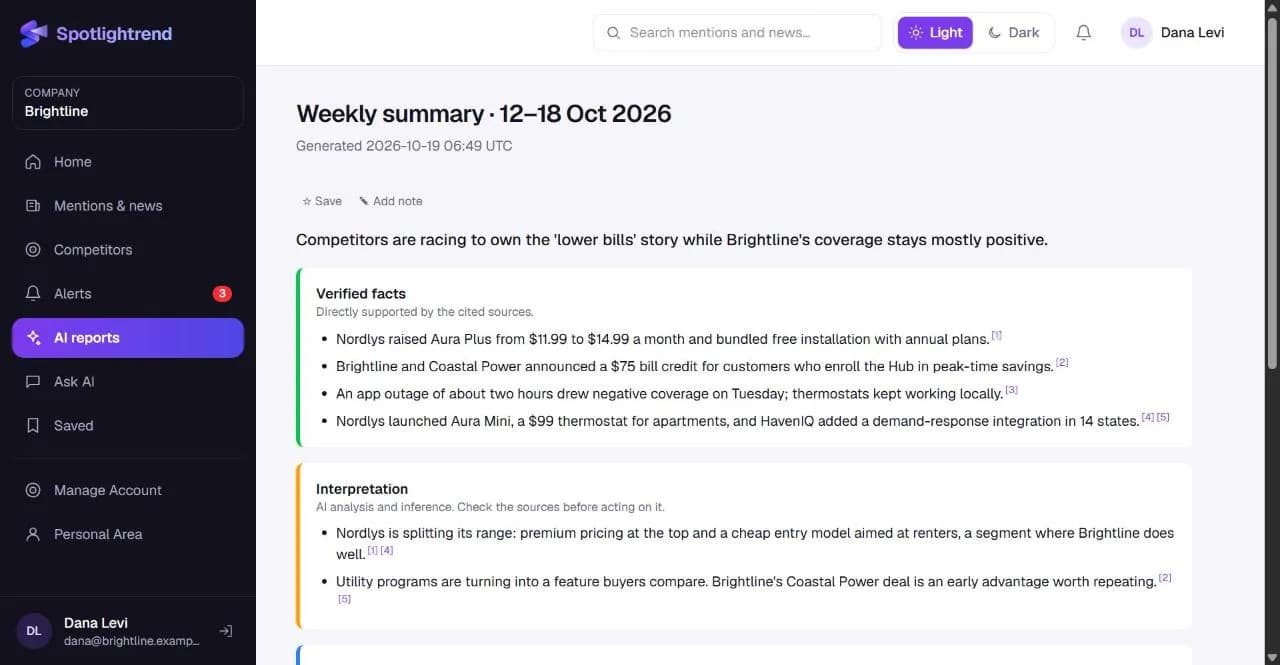
The numbers lead to a source list at the bottom of the report: the article or the competitor change each statement came from. If a fact matters for a decision, click through. It takes five seconds and it's the habit that makes AI reports trustworthy.
Ask AI
Ask AI is for questions the reports don't answer. Type a question in plain language and Spotlightrend answers from what it has collected: your mentions and your competitors' changes. It doesn't use general web knowledge, so it won't invent a competitor's price from memory.
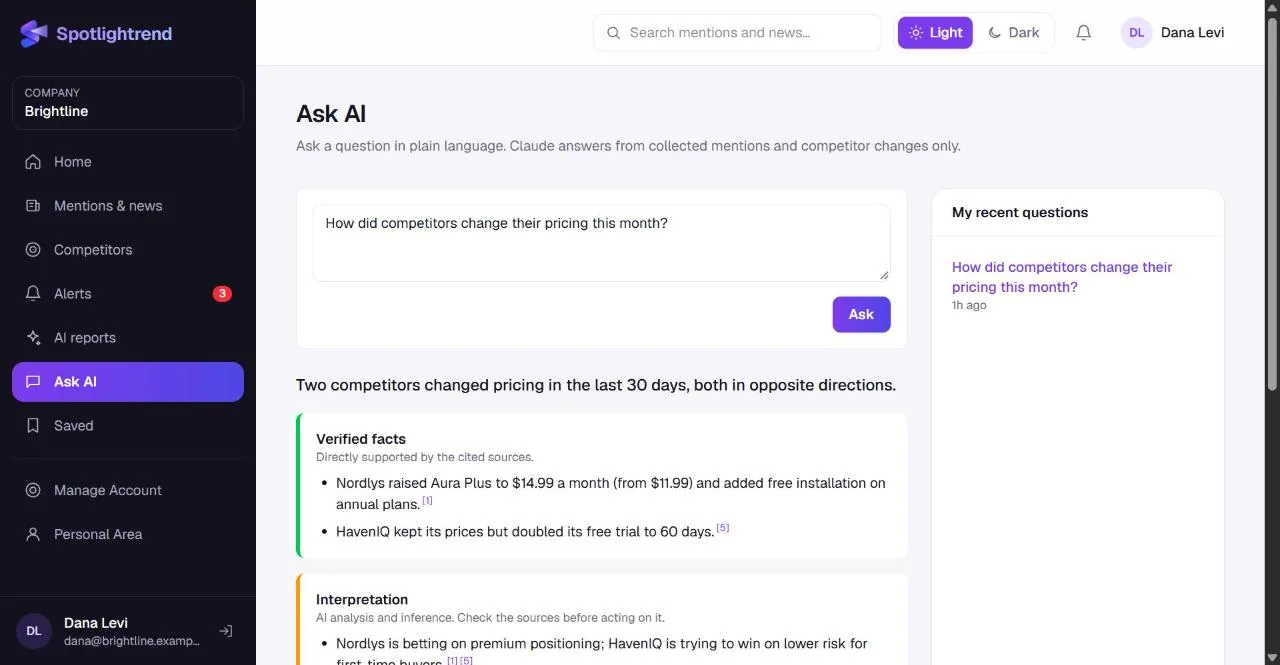
Questions that work well are specific and about your data. A few examples:
- How did competitors change their pricing this month?
- What were the main negative stories about us in the last two weeks?
- Which publications wrote about our new product, and what did they say?
- What did HavenIQ launch since September?
Questions that don't work well are the ones the data can't answer: "What will our competitor do next quarter?" will get an honest answer that there isn't enough evidence, which is the correct answer.
Your recent questions are listed on the right, and the answers are saved so you can share the link with a colleague.
Reading the demo report, line by line
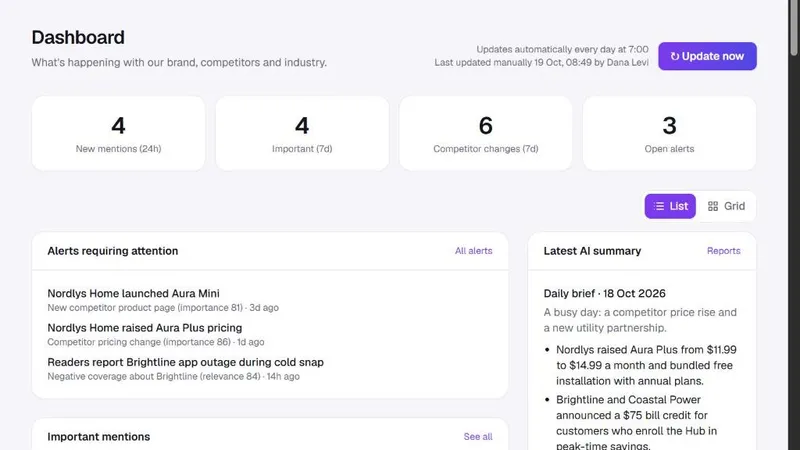
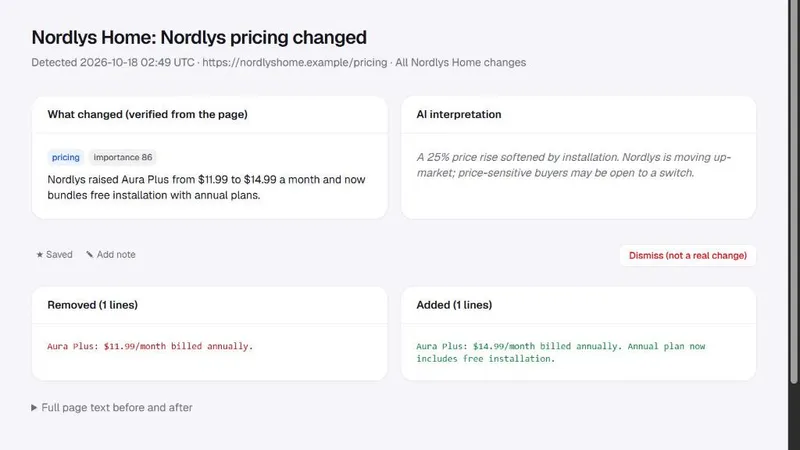
Take the weekly summary in the screenshot above. The headline says competitors are racing to own the "lower bills" story. That's a summary of the interpretation, so it's worth checking the facts underneath before repeating it. Fact one, Nordlys's price rise, links to the page change itself, where you can read the old and new price. Fact two, the Coastal Power partnership, links to the press release. Fact four combines two sources, the new Aura Mini page and HavenIQ's new integration.
Now the interpretation: Nordlys is "splitting its range" with a premium plan at the top and a cheap model at the bottom. Both facts support it, and it's a useful way to frame the week. The opportunities suggest comparing Brightline Hub's total cost with Aura Plus in ads aimed at renters, and publishing a reliability note after the outage. Those are reasonable ideas, and a marketing lead might act on one and ignore the other. That's exactly how they're meant to be used.
What the AI sees
The AI only receives what Spotlightrend collected for your company: article titles, snippets and summaries, and the text of competitor page changes, plus your keyword list so it knows what your brand is. It doesn't see your users, your notes or anything outside your company's account. The AI providers Spotlightrend uses process this data to answer and don't use it to train their models.
Getting better answers
- Name a time window: "this month", "since September", "last two weeks".
- Name the competitor or the topic if you have one in mind.
- Ask one thing at a time. Two short questions give clearer answers than one long one.
- If the answer says there isn't enough data, run Update now or widen the time window.
When the AI gets it wrong
It happens. The most common causes are an article that's only loosely related but mentions your keyword prominently, and a competitor page where unrelated text changed at the same time as something important. In both cases the source is one click away, and the fix is usually upstream: a more specific keyword, a dismissed change, a URL filter on the competitor.
If a report is clearly off, generate it again later after the next update. Reports reflect the data at the time they were made.
AI and your plan
AI features depend on your plan. If they aren't included, collection, competitor tracking, filters and exports still work, and the AI pages explain that the feature isn't part of the plan. Your company admin can upgrade from Change / Update Plan.
Copy the facts section into a weekly update, not the interpretation. Then add your own reading. Leadership tends to trust the result more, and so will you.