Competitive intelligence for marketing teams: a practical guide

"Competitive intelligence" sounds like something with a budget, a dedicated analyst and a quarterly slide deck. For most marketing teams it's simpler and more useful than that: knowing what your competitors are doing early enough to make better decisions about your own work.
This guide is for teams that want that without hiring anyone.
What you're actually trying to learn
Before collecting anything, be clear about the questions. For a marketing team, they're usually some version of these:
- Positioning: How do competitors describe themselves, and is that changing?
- Product: What did they launch, retire or reposition?
- Pricing and packaging: What do they charge, and what's in each plan?
- Messaging and campaigns: Which stories are they telling, and to whom?
- Market perception: What are the press and the industry saying about them, and about you?
Everything you collect should help answer one of these. If it doesn't, it's trivia.
Where the answers are
Most of the useful information is public. It's just scattered.
- Competitor websites: homepage headlines, product and feature pages, pricing, integrations, and the list of pages itself. A new page in a sitemap is often the first sign of a launch.
- News and trade press: funding, partnerships, executive moves, launches and customer stories.
- Your own team: sales calls, support tickets and lost-deal notes. This is the most underused source of all.
The first two can be collected automatically. The third needs a habit, like a shared channel where anyone can drop "a prospect mentioned X today."
Organize around competitors, not sources
A common mistake is to organize research by where it came from: a folder of articles, a folder of screenshots, a spreadsheet of prices. When someone asks "what's going on with Competitor B?", the answer is spread across all three.
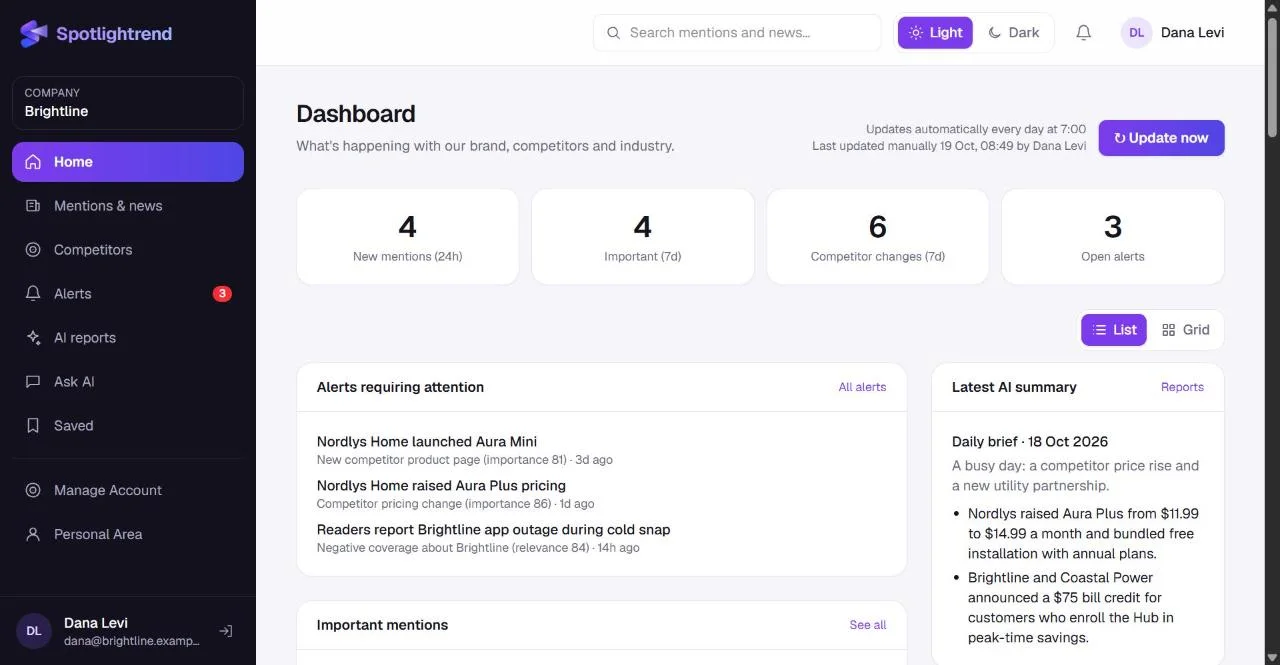
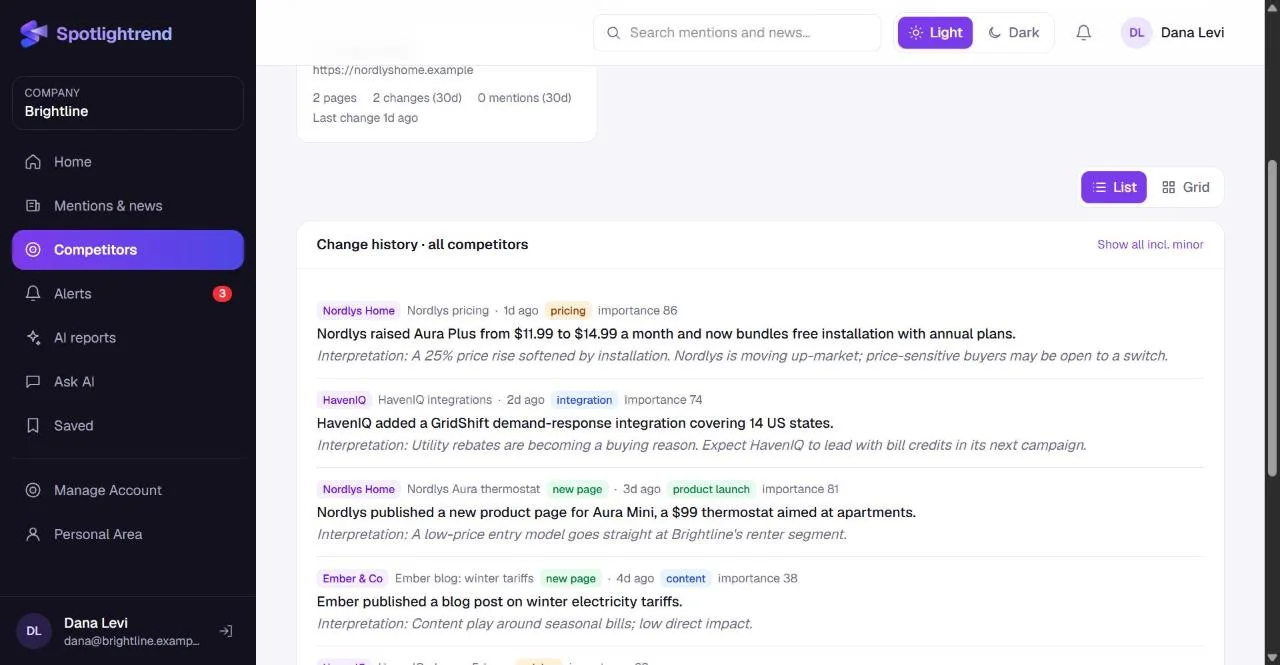
Organize by competitor instead. For each one, keep a running record of changes to their website, mentions in the news and notes from your team, in date order. That record becomes the most useful document in your marketing team, and it's the one that's hardest to rebuild if you don't keep it from the start.
Share it in a format people read
Competitive intelligence that sits in a tool nobody opens doesn't change anything. The format matters more than the volume. What works:
A short weekly summary
Three to five things that changed, one line each, with a link to the source. Send it on the same day every week.
Instant alerts for the big things
A pricing change or a major launch shouldn't wait for Friday. Route those to the people who need them, when they happen.
A quarterly look back
Once a quarter, read the record for each main competitor and write down the direction they're moving in. This is where the real insight usually appears.
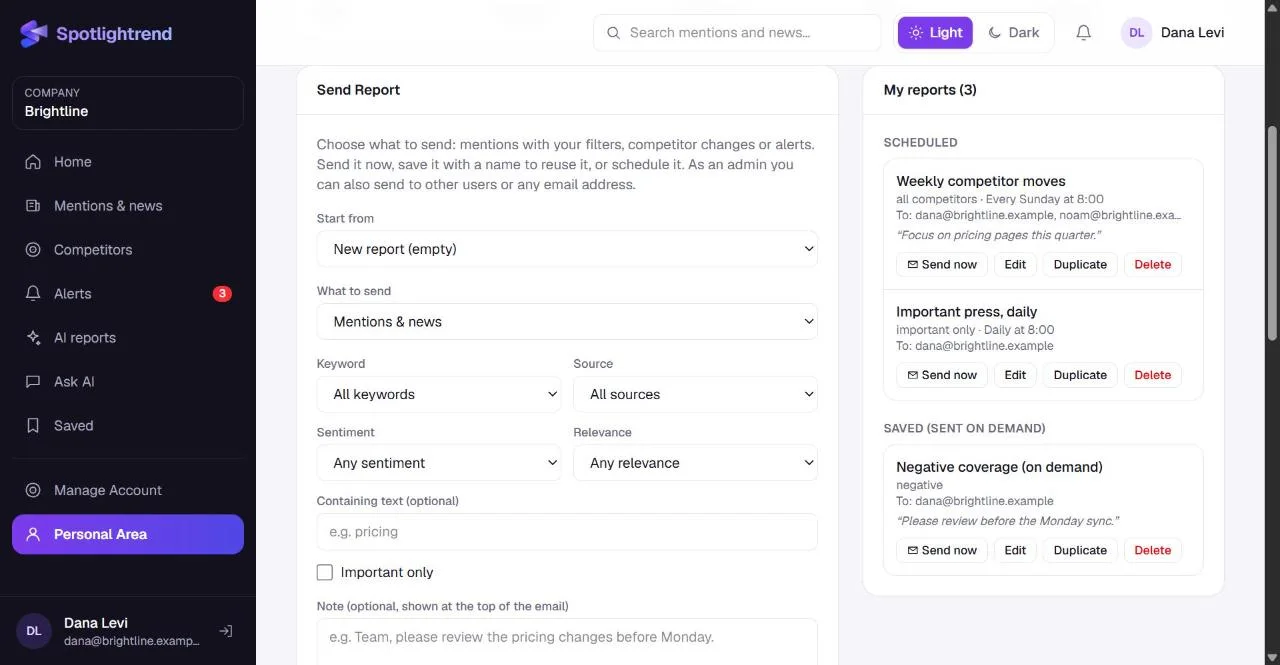
In Spotlightrend you can save a report, schedule it, and send it to the people who need it, with a note at the top. The weekly summary then writes most of itself.
Turn findings into decisions
Every item worth sharing should end with a "so what." A competitor rewrote its homepage around "for enterprise"? That might mean less competition for your mid-market message, or that they're about to come after your biggest accounts. A competitor launched an integration you don't have? Ask sales how often it comes up.
Not every finding needs action, but every finding needs an owner who decides.
Traps to avoid
A few patterns show up again and again when marketing teams start doing competitive intelligence seriously. Knowing them in advance saves months.
- Copying instead of learning. When a competitor launches a new campaign, the reflex is to make a similar one. Ask what problem they're trying to solve first; it may not be your problem at all.
- Tracking too many competitors. Five well-understood competitors beat twenty half-watched ones. Pick the companies you actually lose deals to, plus one or two newcomers worth keeping an eye on.
- Confusing activity with progress. A competitor publishing three blog posts a week isn't necessarily winning. Watch what they change on their own pricing and product pages; that's where real decisions show.
- Keeping it inside marketing. Sales, product and leadership all benefit from the same information. A summary that only the marketing team reads is half wasted.
- Forgetting your own position. Competitive intelligence should also tell you how the market sees you. Read what is written about your own brand with the same attention you give to competitors.
None of these is about tools. They're about keeping the work focused on decisions, which is the only reason to do it in the first place.
Keep it sustainable
The most common reason competitive intelligence fails is that it depends on one enthusiastic person doing manual work. When they get busy, it stops. Automate the collection, keep the record in one shared place, and make the summary a recurring calendar item rather than a heroic effort.
The short version
Know which questions you're answering. Collect from competitor websites, the news and your own team. Organize by competitor, not by source. Share a short weekly summary plus instant alerts for big changes. Give every finding an owner. Then let software handle the collecting, so the team can spend its time on the part only people can do: deciding what it means.
Try it on your own market
Track your competitors and send your first weekly summary this week.